Showing posts with label definition post. Show all posts

Tuesday, 4 October 2016

High Key lighting

High Key lighting is a lighting style for film, television or photography that aims to reduce lighting ratio present in the scene. This was originally done for technological reasons, since television and film didn't deal well with high contrast ratios, but now is used to suggest an upbeat mood.

High key photography is a modern lighting technique that is based on using mid-tone greys through to bright whites. The use of bright lights and lighting to eliminate shadow reduced the contrasts in the picture.


Camera Settings: If the light meter is set to F8, and we want to make it +2 exposure then you add two more f stops to it so it would be F10, if the background is overexposed then you can change it to a lower F stop. We need more light on the background than on the foreground.


Sunday, 7 August 2016

Macro Close up - Definition Post

Magnification:
Macro photography has to do with the size that your subject is projected onto your camera's sensor. If you have a one inch object, its projection at 'life-size' would be one inch on the camera's sensor.

Macro photography is when you photograph a small objects that look larger than life size 

When an object is projected at life size it is called 1:1, this means it is life size, 2:1 means it is double the size

Tips for macro:
  • Use a tripod
  • Explore aperture, the lower aperture may not be suitable as the depth of field is limited
  • Use of additional lighting (flash)
  • Focus manually (decide where your point of focus should be)

This is an example of macro photography, this bug looks incredibly large and on the screen it looks as large as my thumb, however in real life it is probably less than half this size. This type of photography is really interesting and I would like to look at this later in the year when I'm not studying portraiture.


I really like this photograph because the raspberry looks life size whilst the hornets look bigger than life size, I think that this is probably double the size of what hornets actually are. In addition, the small depth of field makes this photograph even better because we can see that there is another hornet in the background, however it is not focused on at all. The viewers eyes are drawn to the three hornets near the raspberry.

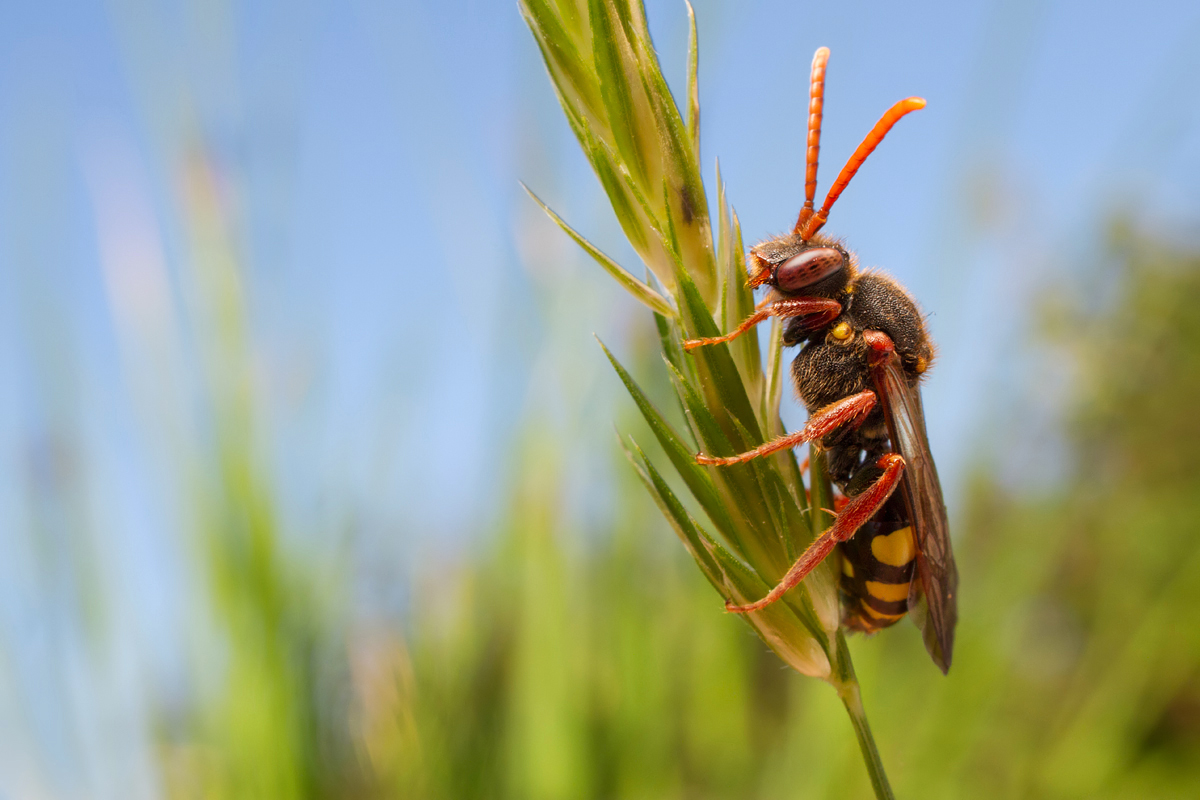
This photograph is really good, I think it is a great example of macro photography. The insect definitely looks larger than life, I also think it is very good because it is only focused on the bug and the thing it has landed on, whereas the photograph before is focused on a few things. The background of this photo is very pretty even though it is blurred out.


Wide Angle and Close up - Definition Post

Close up: A photograph taken at close range or with a long focal-length lens. Usually close up photographs only focus on one thing.
This photograph is an example of a close up photograph because it is only focused on the frogs eye, meaning it has a very small depth of field. I like this photograph because of the use of colour, red and green are opposite on the colour wheel and the two are so different, it makes the photograph more interesting to look out, in addition to this the colours are very bright which also attracts the eye, if the photograph was dull colours I wouldn't be as interested in it.

This is another example of close up photography, I really love this because you can see all the individual raindrops on the ladybird, with the naked eye, you wouldn't see in this much detail. And again the use of red and green really attracts the eye, along with the black which is very bold in contrast.

Wide angle: A wide angle lens is a lens which has a small focal-length compared to the focal length of a normal lens.
This photograph is a great example of how wide angle can distort the subject of a photograph, the head of the goat would not be this big in real life compared to the body, personally I think this is a good effect, it makes the goat the main subject of the photograph, your eyes aren't really distracted much so the goat is the only thing you look at.

This is another example of wide angle photography, this photograph is really nice because it centres on the building in the centre and it is very symmetrical due to the lights on either side of the building. I love how this looks however personally I probably wouldn't try this this term because I want to focus on people for now.

To create this effect you have to use your camera at its most zoomed out, which for my camera lens is 18mm, I also made sure that everything was in focus, this doesn't look as good as it would if I had a specific wide angle lens, although I think it worked pretty well for a normal lens.




Wednesday, 27 July 2016

Sequencing - Definition Post and Image bank

A sequence is a serial arrangement in which things follow in logical order or a recurrent pattern. Photo sequencing is actually stitching multiple images together and it is a form of time lapse photography. A change in an object's position over time is being displayed and it only works when the object moves across a static background

What we need for sequencing:
  • Tripod
  • Fast shutter speed
  • Manual camera settings (to fix the exposure)
  • Manual Focus
  • No camera shake (be careful when pressing the button)
  • Direct the shoot (composition/framing and where the moving elements will move from and to are important)
  • Photo-editing software
This photograph shows somebody doing a series of jumps, this was at least 6 different photographs that have been layered together to show their movements, I really like this because it has a lot of bright colours and it also shows sequencing really well, we can see what the subject was doing and none of the photographs are blurry meaning they were taken using a very quick shutter speed.

This sequencing photograph shows somebody jumping off of a rock, I think that this photograph shows a lot of skill because the photographer only had one chance to take these photographs unless the subject was willing to jump again. In addition I think that the saturation is quite high which really works with this photograph

This photograph shows a man jumping with a snowboard, it has a lot more pictures in it than the other photographs I've look at before now which would've involved a lot of work, these photographs were definitely taken using a tripod and the photographer must've used quick shot to take the photographs because the snowboarder wouldn't have been able to slow down at all.

This sequencing photo is similar to the photograph above, they both show someone doing a flip in the air, I don't like this photograph as much because I personally don't think it's framed very well, the person on the bike is mainly in the bottom part of the photograph which leaves a lot of empty space, unlike the photograph above which hasn't got much empty space. 

Personally I think that sequencing can look nice for things like sports where there is a lot of movement, however if someone is just walking then I think sequencing would look very bad, I also think it has to be well framed, just like with any photograph, although more for this because in some cases it is very difficult to retake photographs and it doesn't turn out well if you haven't thought about framing.